 In Sydney the traditional communities (Cadigal) used the fibres for basket making and string, and the seeds were ground up and cooked over coals to make a dense cake.
Tuesday, January 26, 2010
Mat Rush (Lomandra Longifolia)
Lomandras are native to about half of this continent, excluding the Northern Territory and Western Australia. It is an extremely hardy plant and can survive in a wide range of climates and thrive in a variety of soils including sandy, swampy or clay based, such as ours.
 In Sydney the traditional communities (Cadigal) used the fibres for basket making and string, and the seeds were ground up and cooked over coals to make a dense cake.


Thursday, January 21, 2010
A model forest for food
Meg and I were just in Sydney where we visited the Botanical Gardens to do some research on both Indigenous and exotic foods for a forthcoming project. Stay tuned, but in the meantime check out these Pummelos!


Friday, January 8, 2010
A goose hook
We headed to the lake today.

Zephyr packed a backpack filled with some of his favourite things.

We fished and swam and hung out with the ducks, geese and swamp hens.

And then we noticed this, left by some stupid anthropogenitor.

So with some gleaned street plums we coaxed her closer.
 The way she exorcised the stone from the fruit in one pugnacious motion was miraculous.
 Then I grabbed her around her feet, tucked her under my arm and tried to free the hook.
 It wasn't going to come, so we took her home and called our local wildlife rescue service.
 While we waited we spoke to her gently and offered her some water.
 Then Gayle from the wildlife rescue service arrived and within a few minutes had removed the hook. Gayle rubbed Manuka honey into the wound and returned her to the lake on dusk.

Wednesday, January 6, 2010
Public fruit - social warming
About one year ago I gleaned some early season cherry plums with my friend Pete in Castlemaine, which is a forty minute drive from here. My friend Jason had initially supplied us with a map of where to find them. Cherry plums are probably the first stone fruits to come into season in this region, and we've just discovered a tree about a four minute walk from here. As this lovely specimen is doing so well, survives only on intermittent water from the gods and its own self humus for nourishment, bears delicious fruit free of charge and pesticides, and is growing in the same micro-climate as our own we reckon it's probably a good idea to dry some seeds and attempt to propagate them for future produce.

Until recently our south boundary has bordered a vacant lot, however it has been sold and our new neighbours are getting ready to build. A food producing screen or fence that both sides can harvest could be a nice idea, so I'm going to grow these seeds and suggest this as another type of social warming fence.


Until recently our south boundary has bordered a vacant lot, however it has been sold and our new neighbours are getting ready to build. A food producing screen or fence that both sides can harvest could be a nice idea, so I'm going to grow these seeds and suggest this as another type of social warming fence.

Tom up Tom down
After reading Masanobu Fukuoka's The One-Straw Revolution I decided to conduct an experiment with our tomatoes this year. Fukuoka claims that no plant needs to be staked, pruned or manipulated in any way to give a robust crop. He maintains that just as with any natural farming or gardening system the quality of the soil is of utmost importance to improve productivity and keep pests at bay. He does add however that in the case of already pruned or manipulated plants and trees, such as orchard fruit trees, intervention needs to continue because the risk of disease is high. He is suggesting here, although this is only my interpretation, that one can not easily make wild the cultivated and civilised. I guess this is the problem with an anti-ecological, pro growth-capitalist school system. It churns out young cultivated adults disembodied from wild systems and free-ranging, where wildness is replaced with contained, overly supervised play. The rise in self-harming among young people is possibly one manifestation of this containment.
This year I am planting several varieties of tomatoes through the garden, in various soils and in various sun and shade positions. I'm also staking some and leaving others to grow along the ground at their own will. So far the two strongest plants with fruit already on them are one of each. Both are growing in reasonably developed soil, that are heavily mulched and semi-shaded by our large oak tree. Indigenous grasses, forest gleaned microbes and humus, and horse manure have been added to the environment. So far, between the staked and free-ranging, it's pretty even, however I have more than fifty tomato plants growing, of varying varieties, and will stake half as they develop. Stay tuned for the results later in the season.
 Above. Tomato (Grosse Lisse) staked.
 Above. Tomato (Grosse Lisse) free-ranging.
Tuesday, December 22, 2009
Summer Solstice Produce
This is what we are currently eating from the garden.

And these are what we are currently drying for replanting.

Broad beans are delicious, but they're also good as a soil improver (nitrogen). After I harvested all these beans I pulled up the plants and lay them across the garden bed. Then I raked wood chips over them (carbon). With this as one of our methods our soils are gradually improving season by season, making our garden increasingly productive.
A very merry solstice to you all.
Tuesday, December 15, 2009


Monday, December 14, 2009
Greywater recycling without storage problems
I doubt very much that if you're reading this blog from another country that you live in a drier climate than we do here in Australia. We are becoming increasingly sensitive to the finite resource that is water. Companies bore it from underground stores of collective wealth, pay councils little for it and privatise it in anthropogenic plastic bottles. You can read more about my ongoing bottled water campaign here. Governments stand by and give out long term leases to companies to harvest water for massive profits. It's yet another unsustainable industry that goes against all sensitive and considered social and ecological principals. I call the bottled water industry a perfect example of 'pop fascism'.
So to cut to more positive water-based activities. Yesterday I plumbed in a hose (that I brought at a garage sale for $5) from our bath outlet to the swale. I spent a few more dollars at the local hardware for some connectors. Now, every time we have a bath or a shower the water runs out into and along the swale and seeps under the thickly mulched beds, which will soon be planted with numerous indigenous grasses and sedges, and exotic fruit trees, vegetables and herbs. Keeping produce alive in the summer months has in the past required much dependency on labourious (handheld hose restrictions) watering. This simple, cheap, gravity-fed system of recycling water will cut time, encourage worms and other organisms to thrive in the soil and provide a healthy environment for the plant life. I have been trying to figure out the best way to reuse our greywater, and knew that if I collect it in a tank it would stagnate and become septic unless we were constantly moving it around. By passively harvesting our greywater along the swale, in the soil and with daylight and microbial life engaging with it, it solves all the problems of storing this precious resource.
Just about any small garden can incorporate a swale. If you're considering harvesting your greywater consider a swale rather than a tank. The money and carbon you will save is considerable. Our swale and hose set-up cost about $50. You can do it for less if you hand dig the swale on contour. And yes, it still works in flat gardens, although you'll need to be able to gravity feed your bath water to the swale.
Thursday, December 10, 2009
Two weeks on (swale work)
 Click for bigger.
Two weeks ago we put a swale in and remarkably we have had regular good rain since. This much rain is very unusual for this time of year. It has spurred me on to build more food beds and other functional things (such as an all-weather path running down to the chooks) along the swale. I'm building next door and was able to use the leftover concrete mix (stone and sand) for our new path, laying it on piles of old newspaper. Tonight it rained again, and I was able to capture the swale holding water. It poured down, the swale filled up and over about 30 minutes the rain absorbed into the ground and under the thick mulch.
Saturday, November 28, 2009
Weed not waste not
Weeds get such bad press, though many I'm finding are just plants doing their thing, expanding in any direction habitable, seeking out their own patch of ground where they can make a good life.
And weeds aren't purely florascabs colonising disturbed soils from being eroded either. Many are useful within the food chain and have fantastic health properties for humans. Recently I started harvesting dandelions from the garden for coffee. I used this step by step guide to get me started.
 Dandelion roots washed and ready for roasting.
Friday, November 20, 2009
Making a Swale
We get a fair bit of rain in winter, though little from late spring to late autumn these days. Over the past 10 years the average yearly rainfall has been dropping and it's likely to get worse throughout southern inland Australia. Because of the seriousness of this, and because water is becoming increasingly precious, I decided it time to cut a swale across our 1/4 acre plot for the purposes of harvesting winter water for summer use.

The first thing I did was take my 2m level stick and draw a line across the chosen contour.

I hired Brian and his mini excavator to help break our hard and poor soil, which will soon be full of worms and microbes and rich for growing.
 Brian's work was pretty delicate. We baked in the intense sun, Meg brought out cups of our rain water with sliced lemon and spearmint from the garden. This all took place yesterday.

 We threw the soil (clay and rock) onto our old mattress springs which we placed over one of the compost bays. We sorted out the rocks, pulled out weeds and added vegetable waste, woodchips, horse shit and water to the sifted clay in a lasagna style compost.


 And found that the swale works. Yippee! Now for heavy mulching on either side of the swale – stay tuned.

The first thing I did was take my 2m level stick and draw a line across the chosen contour.

I hired Brian and his mini excavator to help break our hard and poor soil, which will soon be full of worms and microbes and rich for growing.
 Brian's work was pretty delicate. We baked in the intense sun, Meg brought out cups of our rain water with sliced lemon and spearmint from the garden. This all took place yesterday.

Today, Meg and I started to remove the excess rocky clay and fine tune the swale.
 We threw the soil (clay and rock) onto our old mattress springs which we placed over one of the compost bays. We sorted out the rocks, pulled out weeds and added vegetable waste, woodchips, horse shit and water to the sifted clay in a lasagna style compost.

I then had some top soil brought in and Meg and I got to work to spread it out.

A little more fine tuning with the level stick and a rake.

Then tested the level again, this time with water.
 And found that the swale works. Yippee! Now for heavy mulching on either side of the swale – stay tuned.
The whole idea of a swale is for winter rains to collect along it and slowly absorb into the ground instead of draining downhill and away from the produce area. Heavy mulching on both sides preserves the moisture underground which in turn allows for worms, microbes, plants and trees to get established and thrive.
Saturday, November 14, 2009
Warm fish salad
Here is a recipe that pretty much determined itself tonight. Almost all of the ingredients have come from what's on hand in the garden and from the nearby lake – beautiful Lake Daylesford.

Ingredients
Locals:
Baby silverbeet fordhook leaves
Green spouting broccoli
Snow dwarf peas
Sugar snap climbing peas
Spring onion
Spearmint tips
Peppery wild rocket
Baby broad bean leaves
Soft oregano tips
Parsley herb
Lemon (from George and Geoffrey)

Redfin (English perch caught by Meg)

Foreigners:
Tamari and sesame seed oil (to pan cook fish)
Salt and Pepper
Sun-dried Tomatoes
Olive oil
Procedure:
Throw all the herbs and vegetables into a colander and lightly rinse off any soil. Gut, clean and pan fry fish in sesame oil, add tamari and steam with lid to finish off. Remove cooked scales, head and bones and with the raw gut feed to the chooks for extra protein. Lightly toss fish meat in with garden salad and add salt and olive oil.

And now for more Fukuoka:
The result:

Delicious!
And now for more Fukuoka:
Culture is usually thought of as something created, maintained and developed by humanity's efforts alone. But culture always originates in the partnership of man and nature. When the union of human society and nature is realized, culture takes shape of itself. Culture has always been closely connected with daily life, and so has been passed on to future generations, and has been preserved up to the present time. The One-Straw Revolution, 1975, p138.
Combating heat wave in the garden
We have had more than a week of heat wave and I have an uneasy feeling about the Summer to come. There's been talk of record breaking 50+ degree days on the cards and I'm beginning to rethink some of the garden design to combat climate change as it intensifies more rapidly than most of us could have imagined. This post will concern swales, mulch and shade in a bid to retain moisture in the soil.
Swales are specific to a permaculture garden. I have previously dug spoon drains to take heavy winter rains down to the low point of our quarter acre. The water then escapes down a water board drain. What a waste. I now realise my mistake and am about to turn the spoon drain into a swale that instead follows the contour line through to our new food forest area. This way winter rain will remain where it's needed, absorb deep into the soil and be protected in Summer by the heavy mulching we've been undertaking for the past two years.

Above is the food forest area that we've been preparing for the past 6 months. You can just make out the curving spoon drain, edged by indigenous sedges, that wraps behind the chicken coup and off into a drain. We decided that the raised beds were good for raising seeds however we needed a more random, self-seeding area to tend (or no-tend) in a Fukuokian manner. As a transition from this form of growing in raised beds to small-scale food forestry, our sowing and plantings have become more random, dispersing seedlings and seeds throughout the garden, enabling us to conduct companion gardening experiments alongside indigenous plants. We have no pest problems to date, but even if we did all can be treated with natural methods. Intense biodiversity, either natural or created through biomimicry such as in a garden or on a farm, will only improve the health of our environments and therefore the food that we eat.


Above is the newly planted Mulberry tree, planted on the nature strip with local grasses, corn and cucumber seedings. The rocks around the seedlings protect their roots from chicken scratching. The Mulberry has been planted to provide fruit and shade equally. Deciduous fruit and nut trees will also be important to conserve water in the soil by providing shade. Many of our leaf vegetables can't be grown in the hot months with so much burning direct sunlight. Currently a potato crop is planted in the food forest area to help break up the clay. They will relish the sun, however they will also demand more and more precious water. They are growing in only 100mm of compost, horse shit and wood-chips. I'm hoping to get some sort of reasonable crop from them. The soil we inherited is very depressing – disturbed gold-fever clay stained with the blood of the Djadjawurrung. Some colonials however are less violent, and in-fact are a godsend, as the shade from our only mature tree, an English Oak, will attest. Onions, broad beans and rhubarb grow under the oak's semi-shade micro-climate along with indigenous banksias, sedges, poas and lomandras.

Swales are specific to a permaculture garden. I have previously dug spoon drains to take heavy winter rains down to the low point of our quarter acre. The water then escapes down a water board drain. What a waste. I now realise my mistake and am about to turn the spoon drain into a swale that instead follows the contour line through to our new food forest area. This way winter rain will remain where it's needed, absorb deep into the soil and be protected in Summer by the heavy mulching we've been undertaking for the past two years.

Above is the food forest area that we've been preparing for the past 6 months. You can just make out the curving spoon drain, edged by indigenous sedges, that wraps behind the chicken coup and off into a drain. We decided that the raised beds were good for raising seeds however we needed a more random, self-seeding area to tend (or no-tend) in a Fukuokian manner. As a transition from this form of growing in raised beds to small-scale food forestry, our sowing and plantings have become more random, dispersing seedlings and seeds throughout the garden, enabling us to conduct companion gardening experiments alongside indigenous plants. We have no pest problems to date, but even if we did all can be treated with natural methods. Intense biodiversity, either natural or created through biomimicry such as in a garden or on a farm, will only improve the health of our environments and therefore the food that we eat.

When people rejected natural food and took up refined food instead, society set out on a path towards its own destruction. This is because such food is not the product of true culture. Food is life, and life must not step away from nature. Masanobu Fukuoka, The One-Straw Revolution, p.138

Above is the newly planted Mulberry tree, planted on the nature strip with local grasses, corn and cucumber seedings. The rocks around the seedlings protect their roots from chicken scratching. The Mulberry has been planted to provide fruit and shade equally. Deciduous fruit and nut trees will also be important to conserve water in the soil by providing shade. Many of our leaf vegetables can't be grown in the hot months with so much burning direct sunlight. Currently a potato crop is planted in the food forest area to help break up the clay. They will relish the sun, however they will also demand more and more precious water. They are growing in only 100mm of compost, horse shit and wood-chips. I'm hoping to get some sort of reasonable crop from them. The soil we inherited is very depressing – disturbed gold-fever clay stained with the blood of the Djadjawurrung. Some colonials however are less violent, and in-fact are a godsend, as the shade from our only mature tree, an English Oak, will attest. Onions, broad beans and rhubarb grow under the oak's semi-shade micro-climate along with indigenous banksias, sedges, poas and lomandras.

Saturday, November 7, 2009
Local spuds
Meg and I walked to Tipperary Springs this morning and collected Yam daisies from the forest to grow in our garden. Yams are local to this area as well as many other parts of Australia, and were a significant staple for the local mob, the Djadjawurrung. The Yams taste similar to potatoes and have a flower similar to a dandelion.


Monday, November 2, 2009
New Plantings
I planted a Mulberry tree (Morus Nigra) today on the 'nature strip' among the Banksias and Poa Tussocks. I dug through layers of decomposing wood-chips full of rich microbial biology through to the thin layer of top soil, worms and fine gravel until I hit clay. After two and a half years of heavy mulching, composting and broadcasting biodiversity (gleaned in small quantities on forest walks), the hard compacted and heavily disturbed soils that we inherited are starting to become dynamic.
I also borrowed our neighbour Andrew's lawnmower, mowed the areas we haven't mulched as yet and broadcast the clippings onto our very large potato patch to add nitrogen to the carbon rich wood-chips. As I threw a fine layer of clippings I noticed to my surprise that the seed potatoes that I planted only 5 days ago have already begun to pop up through heavy newspaper, horse shit and newish wood-chips comprising mainly native wattles and gums that were thinned out down the road. Folk are busy around here preparing for the fire season. The local arborists sell a truck load (18 cubic meters) of chips for $150. That's $8.35 per meter. In the past two years we've been buying it at the local garden supplies for $33 per meter plus a delivery cost, which has made mulching large areas very expensive.
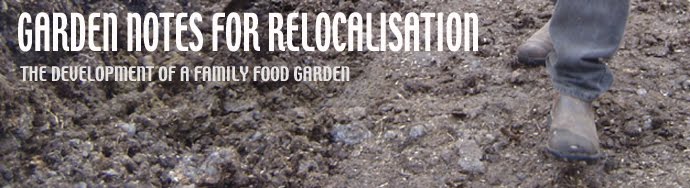
With all the compost we've been making from ours and a local cafe's green scraps (free), chook poo (free), collecting horse shit from the local horse riding school (free) and wood-chips (now only $8.35 a cubic meter), we have a pretty phenomenal programme of soil building for very little expense. The banner image above shows my boots atop the horse shit pile at Boomerang Ranch.
Also this week I planted an excess of white and red onions among indigenous Lomandras and Poas. I also planted some Calendula Meg and Zeph bought at the Sunday market. They flower year round, provide edible petals which are best in salads and tea can be made with them which helps boost the immune system.
Subscribe to:
Posts (Atom)




 Posts