 In Sydney the traditional communities (Cadigal) used the fibres for basket making and string, and the seeds were ground up and cooked over coals to make a dense cake.
Showing posts with label Lomandra. Show all posts
Showing posts with label Lomandra. Show all posts
Tuesday, January 26, 2010
Mat Rush (Lomandra Longifolia)
Lomandras are native to about half of this continent, excluding the Northern Territory and Western Australia. It is an extremely hardy plant and can survive in a wide range of climates and thrive in a variety of soils including sandy, swampy or clay based, such as ours.
 In Sydney the traditional communities (Cadigal) used the fibres for basket making and string, and the seeds were ground up and cooked over coals to make a dense cake.
In Sydney the traditional communities (Cadigal) used the fibres for basket making and string, and the seeds were ground up and cooked over coals to make a dense cake.


Monday, November 2, 2009
New Plantings
I planted a Mulberry tree (Morus Nigra) today on the 'nature strip' among the Banksias and Poa Tussocks. I dug through layers of decomposing wood-chips full of rich microbial biology through to the thin layer of top soil, worms and fine gravel until I hit clay. After two and a half years of heavy mulching, composting and broadcasting biodiversity (gleaned in small quantities on forest walks), the hard compacted and heavily disturbed soils that we inherited are starting to become dynamic.
I also borrowed our neighbour Andrew's lawnmower, mowed the areas we haven't mulched as yet and broadcast the clippings onto our very large potato patch to add nitrogen to the carbon rich wood-chips. As I threw a fine layer of clippings I noticed to my surprise that the seed potatoes that I planted only 5 days ago have already begun to pop up through heavy newspaper, horse shit and newish wood-chips comprising mainly native wattles and gums that were thinned out down the road. Folk are busy around here preparing for the fire season. The local arborists sell a truck load (18 cubic meters) of chips for $150. That's $8.35 per meter. In the past two years we've been buying it at the local garden supplies for $33 per meter plus a delivery cost, which has made mulching large areas very expensive.
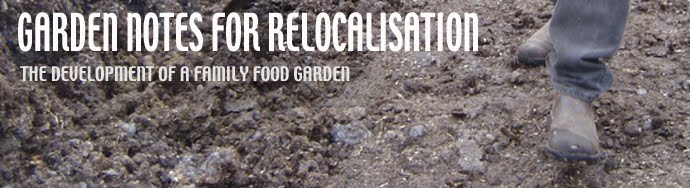
With all the compost we've been making from ours and a local cafe's green scraps (free), chook poo (free), collecting horse shit from the local horse riding school (free) and wood-chips (now only $8.35 a cubic meter), we have a pretty phenomenal programme of soil building for very little expense. The banner image above shows my boots atop the horse shit pile at Boomerang Ranch.
Also this week I planted an excess of white and red onions among indigenous Lomandras and Poas. I also planted some Calendula Meg and Zeph bought at the Sunday market. They flower year round, provide edible petals which are best in salads and tea can be made with them which helps boost the immune system.
I also borrowed our neighbour Andrew's lawnmower, mowed the areas we haven't mulched as yet and broadcast the clippings onto our very large potato patch to add nitrogen to the carbon rich wood-chips. As I threw a fine layer of clippings I noticed to my surprise that the seed potatoes that I planted only 5 days ago have already begun to pop up through heavy newspaper, horse shit and newish wood-chips comprising mainly native wattles and gums that were thinned out down the road. Folk are busy around here preparing for the fire season. The local arborists sell a truck load (18 cubic meters) of chips for $150. That's $8.35 per meter. In the past two years we've been buying it at the local garden supplies for $33 per meter plus a delivery cost, which has made mulching large areas very expensive.
With all the compost we've been making from ours and a local cafe's green scraps (free), chook poo (free), collecting horse shit from the local horse riding school (free) and wood-chips (now only $8.35 a cubic meter), we have a pretty phenomenal programme of soil building for very little expense. The banner image above shows my boots atop the horse shit pile at Boomerang Ranch.
Also this week I planted an excess of white and red onions among indigenous Lomandras and Poas. I also planted some Calendula Meg and Zeph bought at the Sunday market. They flower year round, provide edible petals which are best in salads and tea can be made with them which helps boost the immune system.
Subscribe to:
Posts (Atom)





 Posts
Posts