We've been pretty busy of late designing a public food forest in Sydney.
Follow this community-garden-as-public-artwork here.
Friday, May 21, 2010


Thursday, May 6, 2010


Thursday, April 15, 2010
A greenhouse built with reclaimed materials
Frost season is nearly upon us. So cladding the greenhouse has been a priority. However not wanting to rack up my hardware account or buy new materials, I've been patiently waiting for an alternative to arrive.

Then, a few days ago, Zeph and I were asked to demolish the front laserlight wall of a friend's workshop, as he needs to expand the space. We lucked in big time as Pete gave us the very useful and strong laserlight, along with the hardwood framing material that we'll use for another project. Thanks Pete! Today I was able to clad, or rather semi-clad, the greenhouse.


A few nights ago we thought we were going to have the first frost and I placed the laser light and some salvaged plastic from the building site next door over as much of the pumpkin patch as I could.

Just a few more weeks and we'll have a wonderful harvest, but a heavy frost now will end it all. So on cold, clear and still nights (like this one) I need to set the alarm and get up and hose down the frost before the sun burns the leaves and ends the months of growth for nothing.

After I finished installing the laser light I planted celery, pak choy, mini cauliflower, leek and cabbage underneath.
Wednesday, April 14, 2010
Co-op? Yes please
Cubans today consume about 80% organic food. The food is for everyone, not just for a wealthy few, and as a result diabetes rates are extremely low. Compare this to Australia where only about 4% of the food consumed is organic, often only afforded by the wealthy, in a country that has one of the highest rates of diabetes on the planet. Many of us in this wee community have for some time spoken about the desire for an organic food co-op with an emphasis on local produce. But action hasn't come... until now. Thanks to the energy of those pictured below (Sebastian Klein and Julian Blackhirst) we have a chance at realising this essential community asset.

A COMMUNITY push to form a wholefoods co-operative in Daylesford has gained momentum. A meeting will be held at the Daylesford Neighbourhood Centre on April 26 to gauge interest in the idea and to formulate a plan for getting the idea off the ground. Read on here.
Sunday, April 11, 2010
Preserves for the winter

Fruits we've preserved:
Pears
Plums
Apples
Grapes
Cucumbers
Nectarines
Cumquats
Rhubarb
Quince
Preserving method:
Jam
Jelly
Poach
Pickle
Stew
Other materials:
Salt
Sugar
Honey
Gleaned bottles
Rain water
Piped gas

Rear view
Tuesday, April 6, 2010
Under the soil where the gods will grow
Meg's been making more preserves. The cumquat marmalade she made is awesome. My quince jelly, however, didn't set despite using several green quince which apparently have more pectin in them than ripe ones. Still it tastes great and we will drizzle it over our morning porridge throughout the winter. We're not fans of 'gourmet' preserves, especially ones that use so much sugar and are therefore reliant upon monoculture cane farming. We're going to stick to stewing and poaching using local honey as a sweetener next year. To choose between big agribusiness or the local apiarist is a no brainer.

We had some friends come to stay over the weekend and to celebrate we picked our first-for-the-season pumpkin. It was a little under ripe, but still made an excellent soup. Come on Jack Frost, I know you're lurking, but please hold off a few more weeks!

Zeph and I worked up a sweat today turning the soil and breaking the clods in the north wall patch before planting 100 leek seedlings and 100 garlic cloves. We finished on dark just as the heavens opened and dumped a good fall. A gardener's wish come true.

As we turned and aerated the soil we found big juicy worms, so Zeph marched them down to the chooks to gobble. We're spoiling them more than usual at the moment as we're only getting one egg a day from five hens. The two new chooks are still settling and the pecking order has been interrupted, so it's no wonder they're at odds with their usual laying habits. Meg's been keen to make a zucchini cake, but until the girls start to lay again we can put that delicious ideal on hold.

Friday, April 2, 2010
Self-seeding, quick growing, sewing and storing
The zucchinis have been prolific giving us daily pickings for the past several weeks. Food that is this easy and quick to grow is a blessing. It's odd that something that is this much of a gift is scorned at this time of year. It's also odd that I have so much respect for this fruit when during my childhood I loathed them.
 The eggplants are still providing and we have enjoyed making chips with them on the BBQ. With better soil next year we will be sure to increase the crop.
 We have five small avocados that have self-seeded next to the self-seeded pumpkin patch. We'll see what the frost does to them. At least 5 pumpkins are ready now, but if we don't have a frost for a few more weeks we may have as many as 30 Queensland blues to store. We have an Avocado Bacon on order from the local nursery. They, along with the Hass, are supposed to be best in a cold climate, although we haven't had much luck with our Hass to date.
 Meg's been making cumquat marmalade. Our store of food for the winter is growing with over 40 jars of preserved fruit – grown, gleaned or gifted. We had almost a year's supply of garlic stored from last year's crop and I have been preparing the new garlic bed for this year's planting. Everyone around here has been saying early April is the best time to plant garlic, and not later on the conventional shortest day of the year. The soil is still warm and they seem to kick on until the depth of winter if they're planted now. Garlic and leek will be planted in this patch and possibly some bare-rooted fruit and nut trees later in the winter.

Sunday, March 21, 2010
Eating local is eating in season
We've been eating small variations of practically the same meal for the past several weeks and are strangely enjoying the repetition. It feels increasingly right to be eating repetitively and in season like this. Silverbeet and zucchini have been in abundance, so they have constituted the major source of iron and vitamins. Then we have added basil, garlic, wild rocket, eggplant, potatoes, mint, oregano, tomatoes, cucumber, parsley and onions from the garden, eggs from our lovely girls, and a line-caught redfin or two from the nearby lake. What we then add to these meals are the products we are still reliant upon transporting in. There are usually two or three of the following ingredients with any of our evening meals: salt, pepper, butter, balsamic vinegar, brown rice, sour dough rye bread, or pasta.
In order to keep going with relocalising our food into the colder months, the poly-houses also keep going up over the raised beds.


I also planted 200 more of our saved broad bean seeds on the lower side of the swale (near the pitchfork below). This is to improve the soil quality while providing a hardy winter crop.

Our chooks in chook heaven attending to our city neighbours' neglect of their 'investment' property all throughout the fire season. When non-attendance is a blessing in disguise our chooks will be there to capitalise.

Monday, March 15, 2010
Frugality reality
Preparing for the colder months I started work on a new hothouse today. If we can keep the soil warm and the frost off the leaves our vegies will keep growing through the winter. I sharpened the tips of eight vertical garden stakes and fitted some leftover polypipe over them to make four arches. I then went through the wood pile looking for any length of 4.8m timber and found a piece of decking board, which I ripped into four individual pieces. I then attached the quartered lengths horizontally with tek screws, which bit into the polypipe really tightly. I asked the builders next door if I could have the clear plastic sheets they have lying about to cover material as it arrives. The answer was "shortly". Cool. I'll wait. The frosts are still a few weeks off.
 I thought I'd also include my bike in this shot and show off the new crate that I fixed to it yesterday. I got the crate at the local markets for a few dollars. The hothouse so far hasn't cost us anything as the materials have been reclaimed from here and there over the years. Like the cellar I'm building for next-to-nix, we're really trying to make this transition with as little capital as possible. Although the main house, with double-glazed windows and solar panels was a major capital outlay, something we often question especially at a time of interest rate rises. Eeeeck!
 I thought I'd also include my bike in this shot and show off the new crate that I fixed to it yesterday. I got the crate at the local markets for a few dollars. The hothouse so far hasn't cost us anything as the materials have been reclaimed from here and there over the years. Like the cellar I'm building for next-to-nix, we're really trying to make this transition with as little capital as possible. Although the main house, with double-glazed windows and solar panels was a major capital outlay, something we often question especially at a time of interest rate rises. Eeeeck!
Friday, March 5, 2010
Sowing and picking
We've had rain on and off today, which has come at a time just after I had added horse manure to the north bank garden and turned it over. It's also a few days after the full moon, so what better time to throw around some tree kale seeds and plant some broad beans, collected and dried from spring last year.
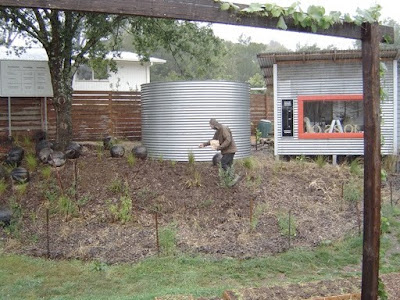 I then picked tonight's dinner veggies in the rain, which we'll have with brown rice and a light smatter of tamari.
 To get decent rain in Autumn is a rare and welcome pleasure. Happy birthday Zephy.
 I then picked tonight's dinner veggies in the rain, which we'll have with brown rice and a light smatter of tamari.
 To get decent rain in Autumn is a rare and welcome pleasure. Happy birthday Zephy.
Thursday, March 4, 2010
From soil to cellar
I've been obsessing over soil building again and obsessing over building things we need in the garden for little or no cost. Things like a cellar for our preserves and somewhere to keep the tools so we can finish the permie-wwoofer-artist-in-res shed – the Shed of Interrelation.
Every time I get in the car of late I'm accompanied by a highly conscious route and list. I leave rambling and fluffing about for when I'm on my bike; when I'm making my own human generated electricity. This morning I had a small list, which required 4.5 km of driving. I headed first to the local cafe where, for the past two years, they kindly donate us their green scraps. Then I headed to the hardware and picked up two polluting bags of cement to use sparingly. I then drove to the nearby horse school farm and shoveled up 6 chaff bags full of lovely crumbly dry shit. When I returned, together with the woodchips we still have left, I prepared a new compost.


I threw everything into the empty compost bay. The cafe scraps ponged because I haven't collected the bin for over a week. This pong is methane being released. It gets like this because the vegetables and fruit are starved of air. A good soil requires water, air, organic matter and many nutrients and minerals. Composting correctly will stop methane being produced. This is called aerobic composting.

Animal manure, green waste (kitchen scraps) and wood chips make a good recipe for soil production. A small quantity of crushed igneous rock will add iron to the brew.

I dump it all in the compost bay and do a work out with the pitch fork. (You can watch a previous workout here). But if you layer your compost like a lasagna you can save on the heavy, back breaking work.

Once turned through I would normally wet down and wrap it up with a tarpaulin. However, we are expecting rain, so I'll save our water and wrap it up afterwards.

Now I have some more cement I can go back to building the cellar. I'm using gleaned gravel and stone, and making a slip wall by clamping boards to the stumps that hold up our house. The cellar should end up costing about $100, if I'm patient and steady-state about it. We have many apples and nectarines to preserve and store from our neighbour Maria's orchard.
Friday, February 26, 2010
Late summer produce
What follows is a visual record of what is currently growing in the garden. Additionally we have potatoes, rhubarb, spinach, silverbeet, basil, leeks, onions, carrots, lettuce, and many herbs to pick.
 Chilli
 Olives
 Lime
 Grapefruit
 Pumpkin
 Zucchini
 Cucumber
 Corn
 Eggplant
 Tomatoes

 Chilli
 Olives
 Lime
 Grapefruit
 Pumpkin
 Zucchini
 Cucumber
 Corn
 Eggplant
 Tomatoes

Monday, February 15, 2010


Saturday, February 13, 2010
Raised beds above the swale
I've just built five new beds above the swale. These beds will grow heirloom vegetables which will be allowed to go to seed and inevitably blow and reembed themselves in the wilder part of the garden, below the swale. This is just following what has already occurred naturally. You can see the self-seeded pumpkin, zucchini and Jerusalem artichoke in background (with the planted potatoes).


Friday, February 5, 2010
24hr food challenge
My family and I conducted an experiment this week. For 24 hours we only ate out of our garden or from what we foraged in the town or caught at the local lake.

For a full summary of the day and the food we consumed visit us here.
For a full summary of the day and the food we consumed visit us here.
Subscribe to:
Posts (Atom)




 Posts